What Should I Post? The 50/30/20 Content Strategy Framework Explained
"What should I post?"
It's the most common question business owners ask when it comes to social media and it's usually followed by one of two things: posting randomly and hoping something sticks, or staring at a blank screen and posting nothing at all.
Neither is a strategy. Both are leaving growth on the table.
The 50/30/20 content framework gives you a simple, repeatable answer to that question. It tells you exactly what types of content to create, in what proportions, and why, so your social media has a purpose behind every post, not just a presence.
What Is a Content Strategy?
A content strategy is a plan for what you'll create, where you'll share it, and why, built around your ideal customer and your business goals.
It's not a posting schedule. It's not a content calendar. Those are tools. A content strategy is the thinking behind the tools, the decisions about what topics you'll own, what your content is designed to do, and how it all connects to turning a stranger into a client.
Without a content strategy, you're creating content. With one, you're building an audience.
The Problem With Posting Randomly
Most business owners fall into one of three content traps:
The Promo Trap: Every post is about the product, the service, or the sale. The audience tunes out because there's nothing in it for them until they're ready to buy and by then, they've already unfollowed.
The Inspiration Trap: Every post is a motivational quote or a generic tip. Engagement is low because the content isn't specific to anyone. It could belong to any account in any industry.
The Disappearing Act: Posting happens in bursts when there's something to announce, then goes quiet for weeks. The algorithm deprioritizes the account, and the audience forgets the brand exists.
The 50/30/20 framework solves all three, by giving every piece of content a job to do.
The 50/30/20 Content Strategy Framework
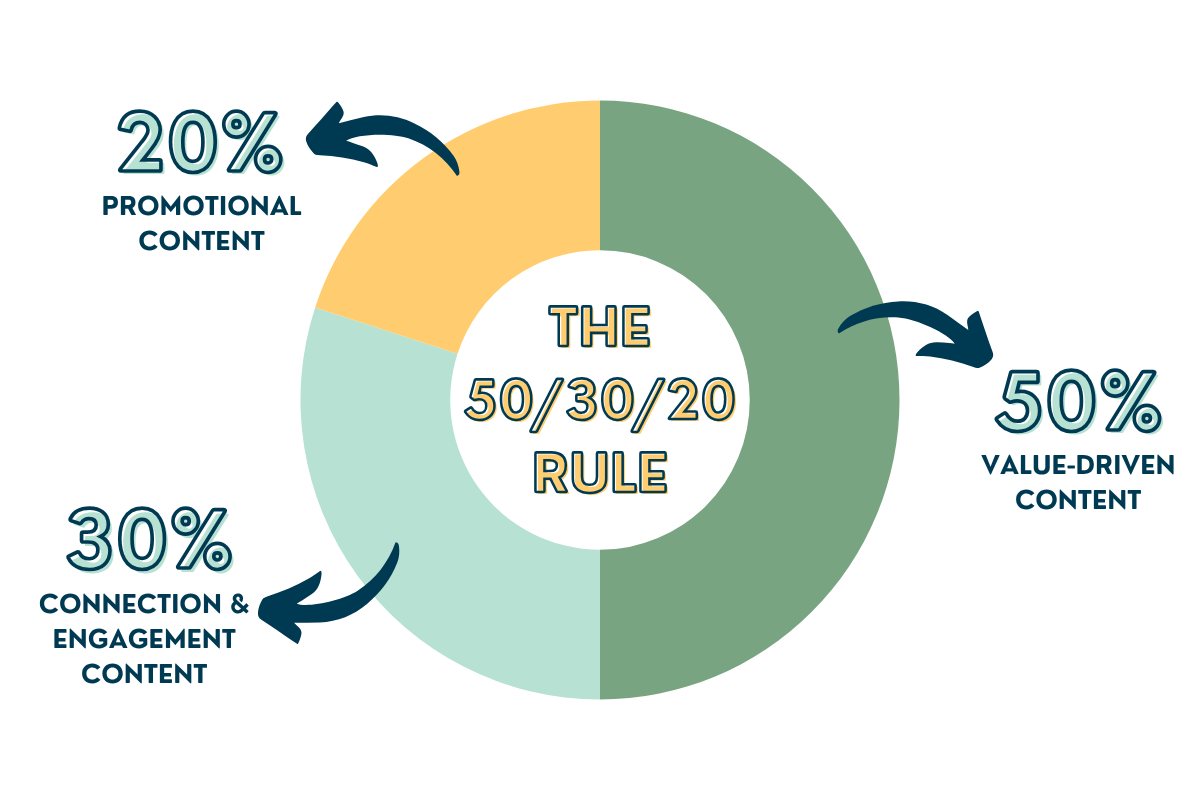
The 50/30/20 framework divides your content into three categories, each with a specific role in building your audience and your business.
50% Value Content
Value content is the foundation of your content strategy. It's educational, informative, or actionable, content that gives your ideal customer something useful without asking for anything in return.
This is the content that earns saves, shares, and follows. It's what makes someone think "this account actually helps me," which is the foundation of every client relationship.
What value content looks like:
How-to posts and tutorials
Tips, frameworks, and checklists
Industry insights and data
Common mistakes and how to avoid them
FAQs your ideal customer is already Googling
The rule: Value content should be about your customer's world, not your business. The more specific and useful it is, the more it travels.
💡 Example for a social media agency: Instead of "We offer social media management," post "5 signs your Instagram bio is costing you followers (and how to fix each one)." Same expertise. One is about the brand. One is for the audience.
30% Connection Content
Connection content is what turns followers into fans. It's the human side of your brand: the stories, the behind-the-scenes, the opinions, the personality that makes someone feel like they know you.
This is the content that earns comments and DMs. It's what makes someone choose you over a competitor with a similar offer, because they feel a relationship with you before they ever reach out.
What connection content looks like:
Behind-the-scenes of your process or team
Your story, how you got here, why you do what you do
Client wins and transformations (with permission)
Your honest take on an industry trend or myth
Personal moments that reflect your values
The rule: Connection content should be specific and real. "I've been in business for 5 years" is a fact. "The client call that made me realize I was undercharging by $500/month and what I did about it" is a story. Stories connect. Facts inform.
20% Promotional Content
Promotional content is where you make the ask. It's the content that directly invites your audience to take the next step — book a call, buy a product, sign up for a service, or join your email list.
Twenty percent feels low to most business owners. It's not. It's exactly right, because the 50% and 30% doing the work ahead of it mean your audience already trusts you by the time you ask. A warm audience converts. A cold one scrolls past.
What promotional content looks like:
Service or offer announcements
Limited-time promotions or launches
Testimonials and case study highlights
Direct CTAs to book, buy, or inquire
"Here's how to work with us" posts
The rule: Promotional content earns its place because of the value and connection content that surrounds it. If your feed is 80% promotional, your 20% value content isn't enough to earn the trust that makes the ask land.
Not sure if your current content mix is working? The Stronger Marketing Audit evaluates your full content strategy: what you're posting, who it's reaching, and whether it's moving your ideal customer toward a decision. Book Your Stronger Marketing Audit for $349 →
How to Apply the 50/30/20 Framework to Your Content Calendar
Knowing the framework is one thing. Applying it is another. Here's how to put it into practice without overcomplicating it.
Step 1: Define your content pillars Content pillars are the 3–5 topics your brand will consistently show up for. They should sit at the intersection of what your ideal customer needs to know and what your business is positioned to teach.
For a social media agency, content pillars might be: social media strategy, content creation, email marketing, paid advertising, and brand building. Every post maps back to one of these pillars — so the account builds authority in a focused area, not a scattered one.
Step 2: Map your pillars to the 50/30/20 split For every 10 posts:
5 posts = Value content (tips, how-tos, frameworks across your pillars)
3 posts = Connection content (stories, behind-the-scenes, opinions)
2 posts = Promotional content (offers, CTAs, testimonials)
This isn't a rigid rule, it's a ratio. Some weeks you'll have more to promote. Some months you'll lean heavier into connection content during a launch warm-up. The framework flexes. The proportion stays roughly consistent.
Step 3: Batch and schedule Plan your content 2–4 weeks ahead. Batching content creation means you're making strategic decisions about what to post, not reactive ones. Scheduling means you're consistent even when life gets busy.
We recommend Metricool for scheduling and tracking performance across all platforms in one place. It's one of the most efficient tools for keeping your 50/30/20 ratio on track and seeing which content type is driving the most results for your specific audience.
The 50/30/20 Framework Across Channels
The 50/30/20 ratio isn't just for social media. It applies across every content channel and when it does, your marketing starts to feel like a system instead of a series of disconnected efforts.
Social media: The primary home of the framework. Value builds discoverability. Connection builds loyalty. Promotional drives action.
Email marketing: Your email list is your warmest audience, people who opted in because they wanted to hear from you. Apply 50/30/20 here too. Not every email should be selling something. The emails that earn the most clicks are usually the ones that teach something first.
Blog content: Value-heavy by nature. Your blog is where you go deep on the topics your social content introduces and where Google and AI tools like ChatGPT find you when someone searches for what you know.
Paid advertising: Your promotional 20% gets amplified here. But the most effective paid ads are built on content that already proved itself organically, value and connection content that earned engagement before becoming an ad.
What the 50/30/20 Framework Is Not
A few common misconceptions worth clearing up before you start applying this:
It's not a rigid formula. If something newsworthy happens in your industry, post about it, even if it throws your ratio off for the week. The framework is a guide, not a rule.
It's not a guarantee. The 50/30/20 split gives your content the right structure. But structure without strategy, without knowing your ideal customer, speaking their language, and showing up consistently, won't move the needle on its own.
It's not a substitute for quality. Five value posts that are vague and generic will underperform two value posts that are specific, useful, and written for exactly the right person. The ratio matters. So does what's inside it.
Frequently Asked Questions About Content Strategy and the 50/30/20 Framework
-
The 50/30/20 content framework is a content ratio that divides social media and marketing content into three categories: 50% value content (educational, useful, actionable), 30% connection content (stories, behind-the-scenes, personality), and 20% promotional content (offers, CTAs, direct asks). It ensures that content builds trust before it makes an ask.
-
Look at your saves, shares, and engagement rate, not just likes. Value content should earn saves. Connection content should earn comments and DMs. Promotional content should earn clicks and inquiries. If none of these are happening, the content may not be specific enough to your ideal customer.
-
Consistency matters more than volume. For most established businesses, 3–5 times per week on a primary platform is a sustainable and effective baseline. Quality and consistency will always outperform a high-volume, low-quality posting strategy.
-
Content pillars are the 3–5 core topics your brand consistently creates content about. They're the foundation of a focused content strategy, without them, content tends to be scattered and doesn't build authority in any particular area. Yes, you need them.
-
Yes. The 50/30/20 ratio applies across channels, not just social media. For email, it means that roughly half your emails should teach or inform, 30% should build the personal relationship with your reader, and 20% should make a direct ask or promote an offer.
-
A content strategy is the thinking, the decisions about what topics you'll own, who you're creating for, and how content connects to your business goals. A content calendar is the execution too, the schedule of what gets posted when. Strategy comes first. The calendar implements it.
Ready to Turn Your Content Into a Strategy?
Posting consistently is a start. Posting strategically is what grows a business.
If you're ready to know whether your current content is actually working and get a clear picture of what to fix, what to double down on, and what to stop, the Stronger Marketing Audit was built for exactly this.
Book Your Stronger Marketing Audit →
Live. 1-on-1. 60 minutes. $349. No pressure. No strings.