What Are the Benefits of Combining Organic Social Media with Paid Advertising Campaigns?
Most businesses treat organic social media and paid advertising like two separate strategies. They're not. They're two halves of the same engine — and when they run together, everything performs better.
If you've been posting consistently but not seeing the reach you want, or you've tried paid ads and felt like you were throwing money into a void, the problem likely isn't either channel on its own. The problem is that they aren't working together.
Here's what changes when they do.
First: What's the Difference Between Organic and Paid Social?
Before we get into the benefits of combining them, let's make sure we're on the same page.
Organic social media is any content you post without paying to promote it — Instagram posts, TikToks, Facebook updates, LinkedIn articles. It shows up in the feeds of your existing followers and, when the algorithm favors it, reaches new people through shares, saves, and hashtags. Organic content builds community, trust, and brand identity over time.
Paid social advertising is content you pay to put in front of a specific audience — whether they follow you or not. Think Meta ads, Facebook ads, Instagram-sponsored posts, and TikTok ads. Paid content lets you target by location, age, interest, behavior, and more. It builds reach and drives faster results, but it costs money to run.
Both have real strengths. Both have real limitations. And that's exactly why they're better together.
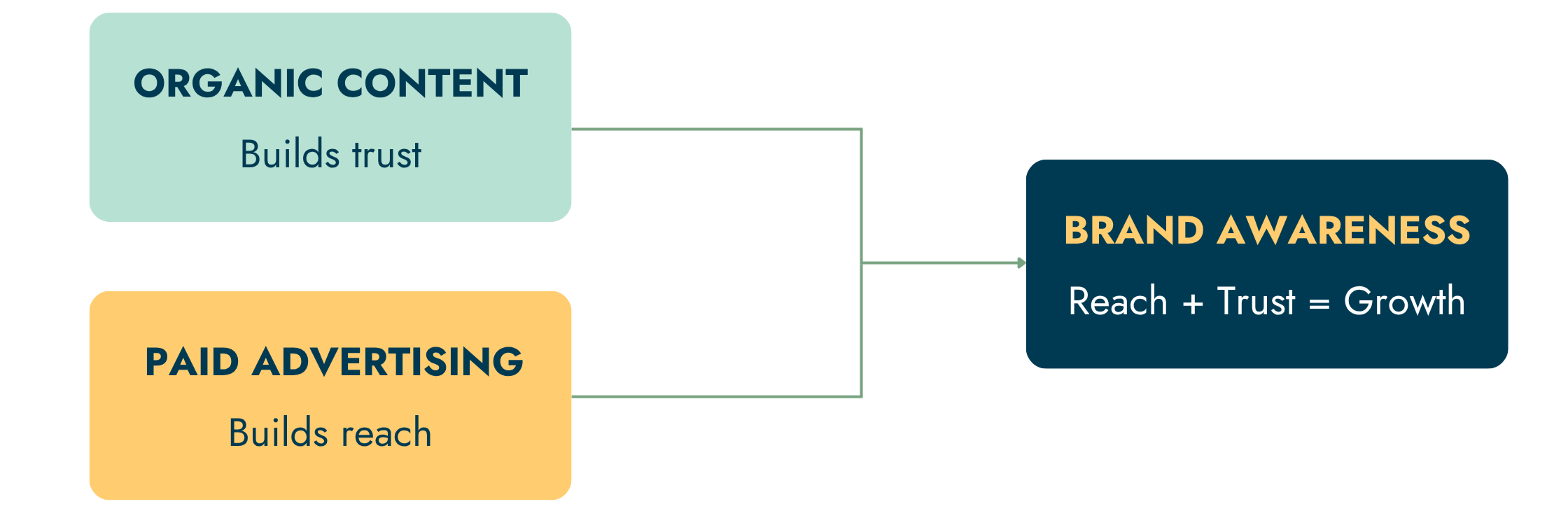
Organic content builds the trust. Paid advertising builds the reach. Brand awareness lives where both meet.
The Benefits of Combining Organic and Paid Social Media
1. Your paid ads perform better when your organic content is strong
Here's something most people don't realize: Meta and other ad platforms reward accounts with strong organic engagement. When your posts are getting saves, comments, and shares, the algorithm trusts your account more — which means your ads get shown to better audiences at lower costs.
Think of your organic content as your credibility score. The higher it is, the more efficiently your paid budget works.
What this looks like in practice: A business running ads on an account with consistent, engaged organic content will typically see a lower cost-per-click and higher return on ad spend than the same ad running on a cold, inactive account.
2. You can turn your best organic content into your best ads
One of the biggest mistakes businesses make with paid advertising is creating brand-new ad creative from scratch without testing it first. The smarter approach? Let your organic content do the testing for free.
When a post gets strong organic engagement — lots of saves, shares, or comments — that's the algorithm telling you this content resonates. That's your next ad.
Boosting or running a formal campaign around content that already proved itself organically almost always outperforms cold ad creative. You're not guessing what will work. You already know.
3. Organic warms up your audience before the ad ever runs
Cold audiences — people who have never heard of your brand — are the hardest and most expensive to convert. They don't know you, they don't trust you, and they're not ready to buy.
Organic social media changes that equation. When someone has seen your content a few times, engaged with a post, or visited your profile before your ad reaches them, they're no longer a cold audience. They're a warm one. And warm audiences convert at dramatically higher rates than cold ones.
This is why consistency in organic content isn't just about growing followers — it's about building a pool of warm prospects your paid ads can tap into.
The retargeting opportunity: Once someone engages with your organic content, you can retarget them with paid ads. This means your ad budget is being spent on people who already showed interest — not strangers who have no context for who you are.
4. You get more touchpoints without proportionally more spend
Marketing research consistently shows that consumers need multiple touchpoints with a brand before they make a purchasing decision — often anywhere from 5 to 8 interactions. Relying on either organic or paid alone makes it hard to create that kind of consistent exposure.
When both channels are running, your audience encounters your brand more frequently — organically in their feed, through a sponsored post, through a share from a friend, through a retargeted ad. Each touchpoint builds familiarity, and familiarity builds trust.
The result is a brand that feels familiar and credible, even to someone who hasn't bought from you yet.
Wondering if your organic and paid efforts are actually working together — or just running in parallel? That's one of the first things Brittany evaluates in the Stronger Marketing Audit — a live, 60-minute deep dive into your full marketing funnel, starting with the channel that's costing you the most. Book Your Audit for $349 →
5. Your data gets smarter across both channels
When organic and paid are running together, you collect richer data — and that data makes both channels perform better over time.
Your organic analytics show you what topics, formats, and tones your audience responds to. Your paid analytics show you which audiences convert, at what cost, and through which creative. Feed those insights back into each other and you create a loop of continuous improvement.
For example: if your organic data shows that educational carousel posts consistently outperform promotional content, and your paid data shows that women aged 35–50 in your area are your highest-converting audience — you now know to build educational carousel ads targeting that demographic. That's a strategy. That's the difference between spending money on marketing and investing in it.
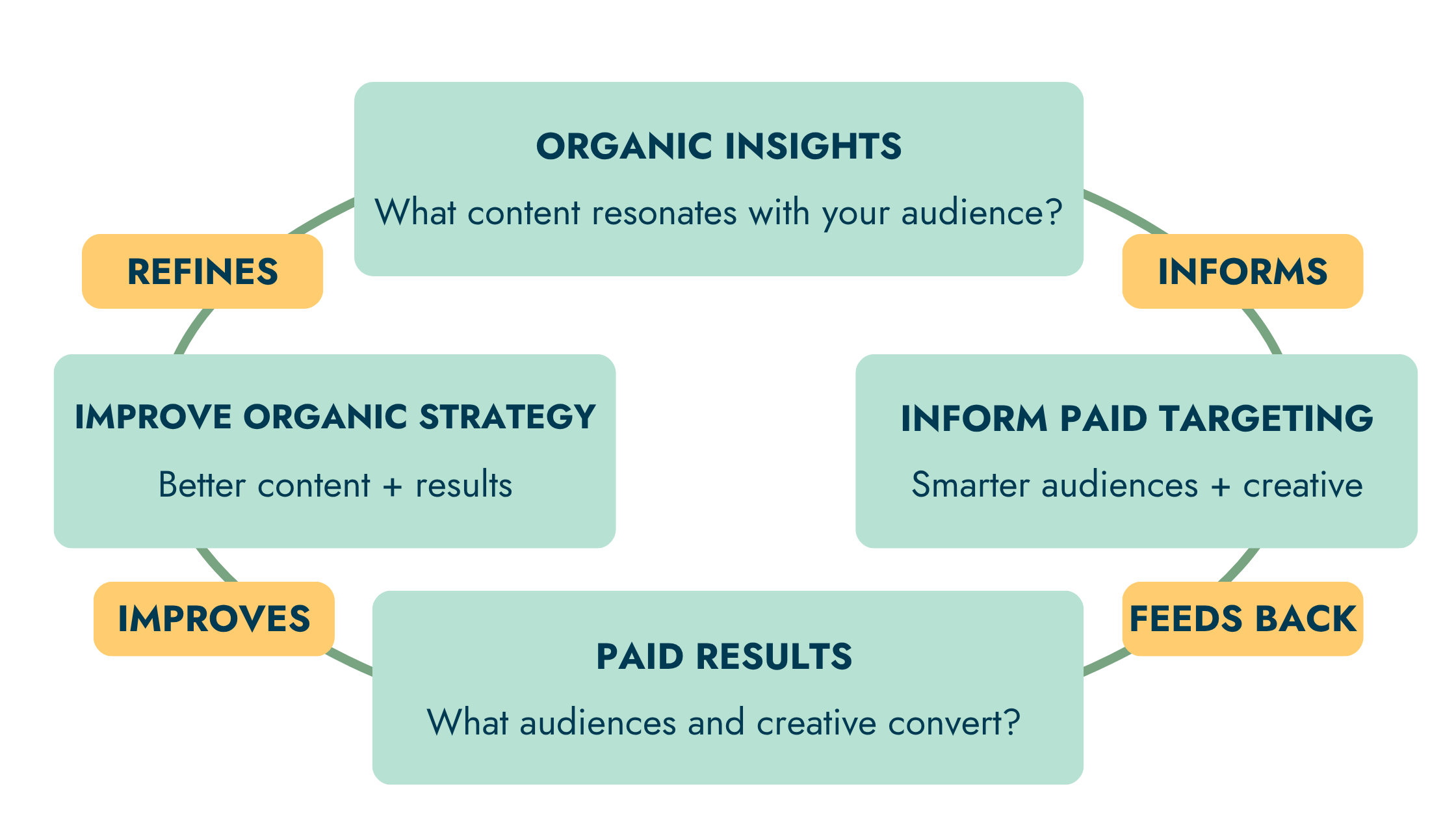
Your organic data makes your paid ads smarter. Your paid results make your organic content better. That's not two strategies — that's one system.
6. You build brand awareness at every stage of the funnel
Organic content is excellent at top-of-funnel awareness — introducing your brand, building credibility, and staying top of mind. Paid advertising can reach people at every stage — from cold audiences who've never heard of you, to warm prospects who visited your website, to past customers you want to bring back.
Together, they cover the full funnel:
Top of funnel: Organic content + broad paid campaigns introduce your brand to new audiences
Middle of funnel: Consistent organic posting builds trust with people who've discovered you
Bottom of funnel: Retargeting ads convert warm prospects who are close to a decision
No single channel does all three well. Both channels together do.
Why Most Paid Ad Campaigns Fail And What to Do Instead
If you've run paid ads before and felt like you wasted money, you're not alone. It's one of the most common frustrations Brittany hears from business owners in the Stronger Marketing Audit. And in most cases, the root cause is the same: the ads were running in a vacuum.
No organic presence warming up the audience. No retargeting strategy capturing engaged visitors. No connection between what the ad promised and what the landing page delivered. No data loop feeding insights from one channel to the other.
Paid advertising without an organic foundation is like opening a store in a new city with no signage, no reviews, and no word of mouth. The store exists — but no one has any reason to trust it yet.
The fix isn't to spend more on ads. It's to build the foundation first.
How The Winfield Creative Combines Organic and Paid for Clients
At The Winfield Creative, organic social media and paid advertising are never treated as separate strategies. Every TWC client benefits from a connected approach — where content informs ads, ads amplify content, and data from both channels feeds back into a smarter strategy.
TWC manages an average of 150 posts per month across clients and drives an average of $1,800 in monthly revenue through email marketing — and those numbers are a direct result of treating every channel as part of a system, not a silo.
Whether you're just getting started with paid ads or you've been running them for years without the results you expected, a connected organic and paid strategy is the single biggest lever most businesses haven't pulled yet.
We use Metricool to plan, schedule, and analyze content across both organic and paid channels — giving us the data visibility to know what's working, what isn't, and where to invest next. If you're managing your own social media, it's one of the most powerful tools available for keeping organic and paid strategy aligned in one place.
Frequently Asked Questions About Combining Organic and Paid Social Media
Do I need a large following before running paid ads?
No — but you do need a credible organic presence. A consistent posting history, on-brand profile, and engaged (even if small) audience tells the algorithm and cold audiences that your business is legitimate. You don't need 10,000 followers. You need a presence that builds trust at a glance.
How much should I spend on paid advertising alongside my organic strategy?
This depends on your goals and industry, but a general starting point for small to mid-size businesses is $500–$1,500/month in ad spend. What matters more than the amount is how the budget is allocated — a mix of prospecting (cold audiences) and retargeting (warm audiences) almost always outperforms either alone.
How long does it take to see results from combining organic and paid?
Most businesses start seeing improved paid ad performance within the first 30–60 days of running a consistent organic strategy alongside campaigns. The organic content builds the warm audience; the paid ads harvest it. The longer both run together, the more efficient the system becomes.
What platforms work best for combining organic and paid?
Meta (Instagram + Facebook) is the most powerful ecosystem for combining organic and paid, largely because of its retargeting capabilities and organic engagement signals feeding ad performance. TikTok is increasingly strong for businesses with video content. LinkedIn works well for B2B service businesses.
Can I manage organic and paid social media myself?
Yes — with the right tools and strategy. Metricool is an excellent platform for managing both organic scheduling and paid ad analytics in one place. That said, most business owners find that the strategy, creative, and ongoing optimization required to make both channels work together is better handled by a dedicated partner.
What is the Stronger Marketing Audit?
The Stronger Marketing Audit is a live, 60-minute 1-on-1 session with Brittany Winfield of The Winfield Creative. It evaluates how your organic content, paid advertising, and email marketing are performing together — and tells you exactly what to fix first. Investment: $349. Includes a full session recording and written recommendations document.
Ready to Stop Running Them in Silos?
Organic social and paid advertising are both valuable. But the businesses seeing the biggest results aren't choosing one over the other — they're building a system where both work together.
If you're not sure whether your current strategy is doing that, the Stronger Marketing Audit is the fastest way to find out.
Book Your Stronger Marketing Audit →
Live. 1-on-1. 60 minutes. $349. No pressure. No strings.